
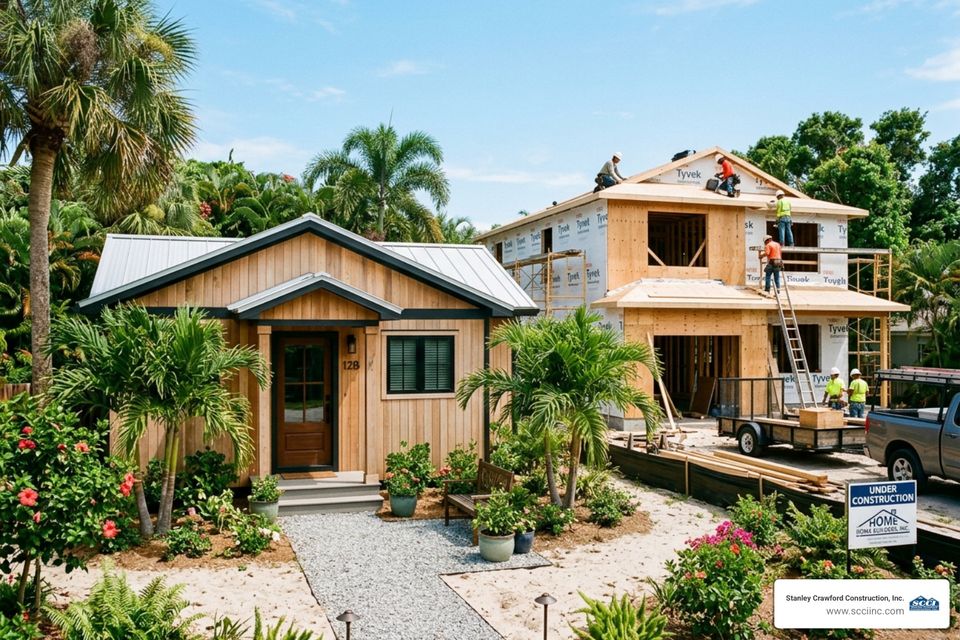
Unlock Your Property's Potential with an Accessory Dwelling Unit
What is an Accessory Dwelling Unit?
An accessory dwelling unit is a second, self-contained living space built on the same lot as a primary single-family home. It has its own entrance, kitchen, bathroom, and sleeping area — completely independent from the main house.
Quick answer: An accessory dwelling unit (ADU) is a smaller, secondary residential unit on the same property as a single-family home. Common examples include:
- A detached backyard cottage or garage apartment
- An attached addition with a private entrance
- An internal conversion like a finished basement or attic apartment
ADUs go by many names — granny flat, in-law suite, secondary suite, backyard home. Whatever you call it, the core idea is the same: one lot, two independent living spaces.
For homeowners in High Springs, Alachua, Gainesville, Newberry, and the Town of Tioga, an ADU can be a smart way to add rental income, house a family member, or simply increase your property's long-term value — all without buying a new lot.
And demand is real. Studies show that 10–20% of housing units in major metros are already informal ADUs. Most were built without permits. That gap between demand and legal supply is exactly why so many states and cities — including Florida — are making it easier to build them the right way.
This guide walks you through everything: what an ADU is, which type fits your property, how local Florida zoning works, how to finance it, and how to build it with confidence.
To truly understand an accessory dwelling unit, we have to look past the "extra room" concept. An ADU isn't just a guest bedroom; it is a complete, independent residence. According to Mass.gov, a unit must provide permanent provisions for living, sleeping, eating, cooking, and sanitation to qualify.
In our experience building across North Central Florida, the "independent" part is what matters most. This means the occupant doesn't need to enter the main house to use the restroom or cook a meal. Whether it’s a detached cottage in High Springs or a converted garage in Gainesville, it must function as a stand-alone home on a shared lot.
Defining the Accessory Dwelling Unit
The "accessory" part of the name is literal. These units are secondary and architecturally diminutive compared to the primary residence. They are legally tied to the main property and generally cannot be sold separately, as noted by the California Department of Housing and Community Development.While the average U.S. household size has dropped from 3.67 people in 1940 to about 2.53 today, our houses have actually gotten bigger. This creates a "mismatch" where many homeowners have more space than they need. An ADU allows you to utilize that extra land or square footage to create a smaller, 1-2 person housing option that fits modern demographic trends perfectly.
Permitted vs. Informal Units
There is a massive "gray market" of informal ADUs across the country—potentially over 14 million nationwide. These are often "bootleg" basement apartments or converted sheds built without permits.At Stanley Crawford Construction, Inc., we always advocate for the permitted route. A legal ADU ensures:
- Safety: Proper egress windows, fire-rated walls, and safe electrical wiring.
- Resale Value: Appraisers can only count the value of living space that has a Certificate of Occupancy.
- Financing: You can’t use rental income from an illegal unit to qualify for a mortgage.
While some cities offer amnesty programs to help homeowners legalize existing spaces, starting your project with the right permits is the only way to protect your investment.
Types of ADUs: Finding the Right Fit for Your Florida Property
Choosing the right type of accessory dwelling unit depends on your lot size, your budget, and how much privacy you want. In North Central Florida, we see a wide variety of styles.The Detached Accessory Dwelling Unit
Often called a "backyard cottage" or "granny flat," the detached ADU is a stand-alone structure. This is the gold standard for privacy. Because it doesn't share a wall with the main house, it’s ideal for long-term renters or independent adult children.The City of Gainesville even offers free pre-approved plans for these units to help residents move through the process faster. These detached units are often 33-44% smaller per capita than standard rental units, making them much more efficient to heat and cool in our Florida summers.
Attached and Internal Conversions
If you don't have the backyard space for a separate building, you can look closer to home—literally.- Attached ADUs: These are additions that share at least one wall with the main house but have their own entrance. We often see these as attached garage editions.
- Internal Conversions: This involves turning an existing part of your home, like an attic or a "bump-out" addition, into a separate unit. In some areas, these are called Junior ADUs (JADUs) and are usually capped at 500 square feet.
If you're considering expanding your current footprint, check out our complete guide to house additions for more inspiration on how to blend these units seamlessly into your existing architecture.
Navigating Zoning and Regulations in Alachua County and Gainesville
Before you pick out the flooring, we need to talk about the "boring" stuff: zoning. Florida has been proactive in encouraging ADUs to solve housing shortages. Florida Statute 163.31771 specifically addresses ADUs, encouraging local governments to allow them as a way to provide affordable housing for the elderly and low-income residents.Local Permitting in High Springs and Newberry
Each municipality has its own flavor of rules. In Alachua County, the regulations focus on ensuring the ADU remains "accessory" to the main home. This means looking at:- Setbacks: How far the unit must be from your property line.
- Lot Coverage: Ensuring you don't pave over too much of your "green space."
- Height Limits: Making sure your new cottage doesn't tower over the neighbor's yard.
In places like the Town of Tioga or Newberry, there may also be specific architectural standards to ensure the new unit matches the aesthetic of the neighborhood.
Size and Parking Restrictions
One of the biggest hurdles in the past was parking. However, many modern ordinances (like those in Gainesville) have relaxed these rules. Often, if you are within a certain distance of public transit, you may not be required to add a new off-street parking space at all.As for size, most local codes cap an accessory dwelling unit at around 900 square feet or a certain percentage of the main house's size. This keeps the unit "diminutive" and ensures it doesn't overwhelm the primary residence. For a deep dive into the local permit process, the Gainesville 2026 Guide is an excellent resource for current timelines and requirements.
The Financial Benefits and Financing of Your Accessory Dwelling Unit
Building an ADU is an investment, but it’s one with a very high "return on life." Beyond just dollars and cents, it provides a place for family to stay close while maintaining boundaries.Financing Your Accessory Dwelling Unit
Many people don't realize that you can use traditional mortgage products to build an ADU. Fannie Mae offers several options:- HomeStyle Renovation: This allows you to wrap the construction costs of an ADU into your primary mortgage.
- HomeReady: This is a great option for purchasing a home that already has an ADU. You can even use the projected rental income from the ADU to help you qualify for the loan!
- Construction-to-Permanent: If you are building a new custom home with us, we can include the ADU in the initial build using this financing.
By using these tools, you aren't just spending money; you're building equity. A well-designed ADU can significantly increase your property's resale value, often paying for itself through rental income in just a few years.
Economic and Environmental Impact
ADUs are a "win-win" for the community. Because they use existing infrastructure (like roads and water lines), they are much more environmentally friendly than building a new subdivision out in the woods.They also provide "invisible" affordable housing. A detached ADU is typically more affordable than a standard apartment because the "land cost" is already covered by the homeowner. This allows seniors to "age in place" by moving into the smaller ADU and renting out their larger main house, or vice versa.
Steps to Building Your Custom Accessory Dwelling Unit
Building an accessory dwelling unit is a journey. At SCCI, we’ve been guiding Florida homeowners through this for over 40 years. Here is how the process usually looks:Site Assessment: We look at your lot, check for utility connections (water, sewer, electric), and verify your zoning.
Design: We create custom floor plans that maximize every square inch. Since ADUs are small, smart design is everything.
Permitting: We handle the paperwork with Alachua County or the City of Gainesville to ensure everything is "by the book."
Construction: From the foundation to the final coat of paint, we manage the subcontractors and the timeline.
Inspections: We coordinate with local officials for the final inspections to get your Certificate of Occupancy.