Stop Dreaming and Start Building with These Custom Home Design Plans
Why a Custom Home Design Plan Is the First Step to Your Dream Home
A custom home design plan is a complete set of architectural drawings made specifically for your home, your land, and your life — built from scratch rather than pulled off a shelf.
If you're looking for a quick answer, here's what a custom home design plan typically includes:
- Floor plans — room layouts and dimensions for every level
- Exterior elevations — what each side of the home looks like
- Foundation plan — engineered for your specific soil and site
- Roof plan — pitch, structure, and drainage layout
- Electrical plans — outlet, switch, and fixture locations
- Wall sections and framing details — how the structure goes together
- 3D renderings or virtual tours (depending on your design package)
Unlike stock plans you download online, a custom plan is designed around your lot, your family's routines, and local building codes — including the Florida Building Code requirements that apply across High Springs, Alachua, Gainesville, Newberry, and the Town of Tioga.
That distinction matters more than most people realize. A plan that looks perfect online may not account for your lot's slope, North Central Florida's clay soils, wind load requirements, or your HOA's setback rules. Getting those details wrong early is where delays and costly change orders are born — and the industry average for change orders runs between 10–15% of total project cost.
As a premier custom home builder in Gainesville, High Springs, Alachua, Newberry, and the Town of Tioga, Stanley Crawford Construction, Inc. has seen how a well-designed, site-specific plan sets the entire build up for success. And we've also seen what happens when homeowners skip that step.
This guide walks you through everything — from choosing between custom and stock plans, to understanding what goes inside a complete drawing set, to navigating permits in Alachua County and beyond.
Custom vs. Pre-Designed Stock Plans: Which is Right for You?
When you decide to build a home in North Central Florida, you generally face a fork in the road: do you buy a pre-designed stock plan online, or do you invest in a tailored custom home design plan?Stock plans are pre-made, catalogued blueprints that have been designed to fit a generic lot. While they are often cheaper upfront and available for immediate download, they frequently fall short when it comes to site-specific design and true design flexibility.
A custom blueprint, on the other hand, begins as a blank canvas. It is drawn to match the exact dimensions of your property, the way the sun hits your lot, and the specific daily habits of your family. Furthermore, working on a custom plan gives you the benefit of direct designer communication.
Instead of trying to guess what a third-party website meant by a specific framing detail, you have a direct line to the professional who drew the lines. This collaborative relationship ensures that your design choices are realistic, buildable, and tailored to your budget.
When we look at the numbers, the difference between these two paths is stark. Detailed, builder-ready custom construction documents keep the building process incredibly smooth. In fact, while the industry average for construction change orders sits between 10% and 15%, projects built with highly detailed, custom-tailored plans see an average change order rate of less than 2%. This translates to tens of thousands of dollars saved and months of avoided delays.
To help you visualize the differences, here is a quick breakdown:
FeaturePre-Designed Stock PlansCustom Design PlansUpfront CostLower ($1,000 - $3,000)Higher (Variable based on SF)
Site AdaptabilityPoor; requires manual modificationExcellent; designed specifically for your lot
Florida Code ReadinessRarely compliant with local wind loadsBuilt specifically to meet local Florida codes
Design FlexibilityLimited; changes require costly hourly draftsUnlimited; built around your lifestyle
Designer AccessNone or very limited third-party supportDirect, ongoing communication
Average Change Orders10% - 15%Less than 2%
If you are trying to decide which route fits your goals, reading through our guide on Navigating the World of Custom Home Blueprints Recommendations and Resources can help you weigh your options with confidence.
Designing for North Central Florida's Unique Terrain
One of the greatest limitations of stock plans is their complete disregard for local geography. North Central Florida is famous for its beautiful, rolling landscapes, but these features present real construction challenges that require a site-specific custom home design plan.Our local lot topography is rarely perfectly flat. If you are building in the rolling hills of High Springs or Alachua, your home must be designed to handle elevation changes gracefully. Forcing a flat stock plan onto a sloped lot often results in massive, unexpected dirt-work bills or awkward foundation exposures.
Additionally, we must design around North Central Florida's clay soils. Unlike the sandy coastal regions, our clay soils expand and contract, meaning your foundation plans must be engineered with precision to prevent cracking and shifting over time.
Then there are the magnificent mature oaks that define the beauty of neighborhoods in Gainesville and Newberry. A custom design allows us to position your home to preserve these stunning trees, framing them through your windows rather than clearing them out.
Finally, our climate demands a focus on seamless outdoor living. A great Florida design prioritizes deep shaded porches, summer kitchens, and screened lanais that keep the bugs out while letting the breeze in. To see how these regional factors come together, check out A Comprehensive Guide to Design Your New Home in Gainesville FL.
The Anatomy of a Complete Custom Home Design Plan
A complete set of custom home construction drawings is much more than a simple layout of where the couches go. It is a highly technical, multi-page instruction manual for your builder, subcontractors, and local building inspectors.When you receive a professional, permit-ready custom home design plan, it typically contains the following essential components:
- Cover Sheet & Site Plan: The cover sheet establishes the project's parameters, while the site plan shows exactly how the home sits on your lot, including setbacks, driveway locations, and utility connections.
- Floor Plans: Detailed overhead views of every level, showing wall thicknesses, room dimensions, door swing directions, and window locations.
- Exterior Elevations: Two-dimensional drawings of the front, back, left, and right sides of the home. These show exterior materials, roof heights, and overall aesthetic styling.
- Foundation Plans: Detailed structural layouts specifying concrete footings, slab thickness, and reinforcement details tailored to local soil conditions.
- Electrical Plans: Layouts indicating the exact placement of outlets, light fixtures, switches, smoke detectors, and smart home wiring.
- Roof Plans: A birds-eye view of the roof structure, highlighting hips, valleys, pitches, overhangs, and drainage systems.
- Typical Wall Sections & Framing Details: Cross-section drawings showing how the foundation, walls, and roof connect. This is crucial for understanding insulation values and structural integrity.
In 2026, the best custom design services also include advanced visual tools. Instead of forcing you to mentally translate flat 2D lines into a 3D space, modern design packages utilize 3D renderings and immersive virtual tours. These digital walk-throughs allow you to experience the spatial flow, test furniture placement, and see exactly how natural light will move through your rooms before a single nail is driven.
If you want to explore the digital drafting tools that make this possible, take a look at our breakdown of the Unleash Your Inner Architect Top Tools to Design Your Own House Blueprints.
Essential Elements of a Florida-Ready Custom Home Design Plan
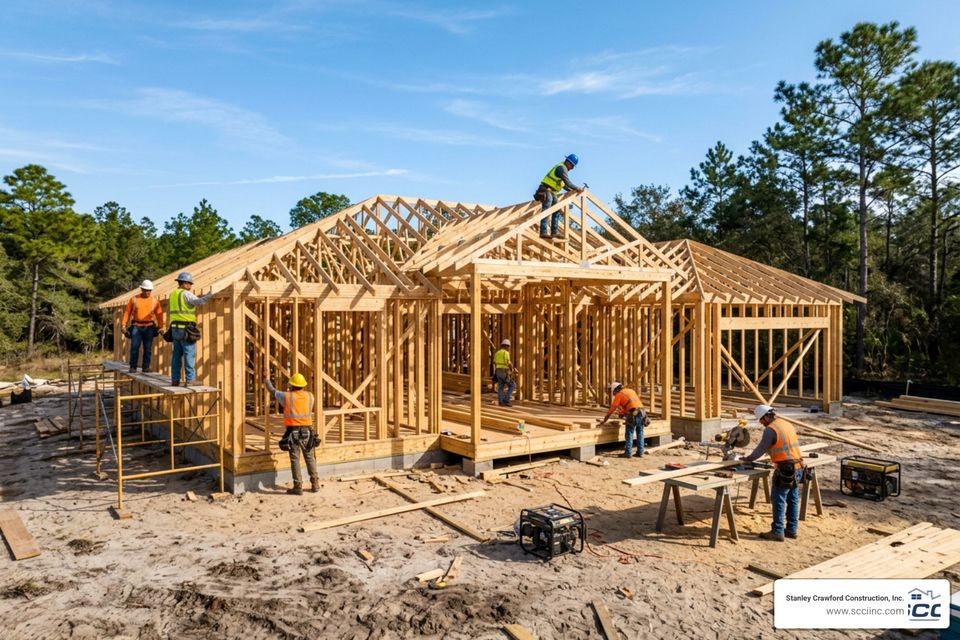
Building in Florida means designing a structure capable of standing up to Mother Nature. A generic plan from a national website simply won't cut it under the strict guidelines of the Florida Building Code.First and foremost, your design must incorporate precise wind load calculations. In our region, homes must be engineered to withstand winds ranging from 120 to 140+ mph. This requires specialized hurricane-resistant framing, including continuous metal tie-down straps that anchor your roof trusses all the way down to the concrete foundation.
Energy efficiency is another critical factor. With our hot, humid summers, your plan must optimize solar orientation. This means placing large windows thoughtfully to maximize natural light without turning your living room into a greenhouse. Your blueprints should also specify advanced moisture barriers and high-performance insulation systems to keep humid air out and cool air in, keeping your utility bills manageable.
Navigating the Custom Home Design Process
Designing a custom home is an exciting, collaborative journey. At Stanley Crawford Construction, Inc., we believe the design process should be highly transparent, keeping you in control of both the creative vision and the budget.The entire process is broken down into distinct design phases to ensure no details are missed. By utilizing live collaboration—such as interactive screen-sharing sessions where you can watch your designer adjust the 3D model in real time—we can streamline communication and establish clear timeline expectations. Most custom plans take anywhere from 2 to 6 weeks to finalize, depending on how quickly decisions are made and how complex the home is.
To get a complete sense of how this journey unfolds from your initial ideas to a construction-ready blueprint, read A Practical Guide to Custom Home Design Process.
Step-by-Step: Crafting Your Custom Home Design Plan
To give you a clear roadmap of what to expect, here is how we guide you through the creation of your custom drawings:Discovery Call & Consultation: We start with an introductory conversation to discuss your lifestyle, design inspiration, target budget, and must-have features. To prepare for this step, review our Step by Step Guide to Home Design Consultation.
Site Analysis: We analyze your lot's physical characteristics, including soil quality, topography, mature trees, and local zoning or HOA restrictions.
Concept Sketches (50% Design): Your designer drafts initial floor plan layouts and basic exterior shapes. This is where we establish the general flow of the home and make sure the rooms are scaled perfectly to your daily routine.
Design Development (90% Design): Once you approve the concept, we flesh out the details. We add windows, doors, electrical layouts, and interior elevations while refining the exterior look.
Final Construction Documents: We finalize all dimensions, structural details, and material specifications, delivering a complete, permit-ready set of blueprints.
Understanding Costs, Pricing Tiers, and Budgeting
When it comes to budgeting for your custom home design plan, clarity is key. Design costs are typically structured around square footage rates, with pricing tiers reflecting the level of detail and personalization you require.- Starter / Essentials Packages (approx. $1.50 - $2.15 / SF): These packages provide the core blueprints needed for permitting and basic construction, including floor plans, basic elevations, and standard foundation layouts. They are ideal for straightforward builds on uncomplicated lots.
- Ultimate Packages (approx. $2.50 - $4.00 / SF): These packages add highly detailed interior elevations, comprehensive electrical layouts, and advanced visual aids like photorealistic 3D renderings and virtual walk-throughs.
- Full Design Partnerships (up to $9.00 / SF): This tier offers complete, hands-on architectural involvement, including full material specifications, fixture selections, and direct coordination throughout the entire building process.
Note: Most custom design projects carry a minimum fee ranging from $2,500 to $3,500 to cover the initial site analysis and setup.
Investing in a detailed plan upfront is the best defense against "scope creep"—the gradual, expensive accumulation of small changes made mid-construction. When plans are vague, builders have to make assumptions, which leads to costly change orders. A highly detailed drawing set keeps everyone on the same page and keeps your budget on track. Learn more about managing your budget effectively in Custom Built Home Designs That Won't Drive You Crazy.
What Influences the Cost of Your Custom Home Design Plan?
Several key factors will influence where your design fees fall within these pricing tiers:- Architectural Complexity: Homes with intricate, multi-level rooflines, complex footprint shapes, or soaring cathedral ceilings require significantly more drafting and engineering time than simple, rectangular designs.
- Site Constraints: If your property has steep slopes, unusual shapes, or strict environmental protections, the site plan and foundation design will require extra attention.
- Local Engineering Requirements: Florida's high wind zones mean that structural engineering fees are a necessary part of the process.
- Community Guidelines: Building in highly curated developments, such as the Town of Tioga Community, requires strict adherence to specific architectural guidelines and HOA review board approvals, which can add steps to the design phase.
Ensuring Code Compliance and Permitting in North Central Florida
Once your custom home design plan is complete, it must pass through the local municipal permitting process before construction can begin. Navigating these regulations requires deep local expertise.In our region, permitting is handled at the county or city level. If you are building outside city limits, you will work with Alachua County regulations, which place a heavy emphasis on environmental protection, stormwater management, and strict adherence to the Florida Building Code. If your lot is within municipal boundaries, you will coordinate with City of Gainesville permitting or the local building departments in Alachua, High Springs, and Newberry.
To secure your building permits, your custom plans must be accompanied by site-specific structural engineering calculations. This means a Florida-licensed structural engineer must review and stamp the plans, verifying that the foundation, wall framing, and roof tie-downs are fully engineered to handle local wind loads.
Working with a local design-build team like Stanley Crawford Construction simplifies this entire headache.
Because we build in these municipalities every day, we know exactly what local plans examiners look for, helping you avoid costly delays during the review process. To see how the permitting phase fits into the broader construction timeline, read about the Custom Home Build Process From Blueprints to Better Living.
For specific details on local building codes and submission guidelines, you can visit the Alachua County Building Regulations portal.