Moldy Bathroom Blues? Here's How to Tackle Remediation Like a Boss
Bathroom Mold Is a Bigger Problem Than It Looks
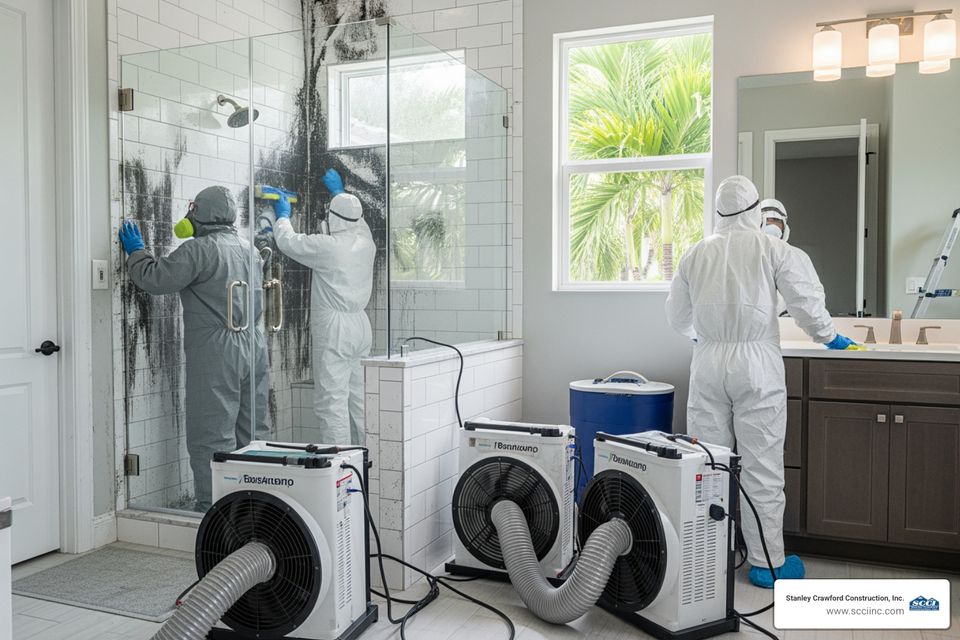
Bathroom mold remediation is the process of safely identifying, removing, and preventing mold growth in bathrooms — and in Florida's humidity, it's a problem that can get out of hand fast.
Here's a quick overview of what the process involves:
Assess the size of the mold growth (small, medium, or large)
Identify the moisture source (leaks, poor ventilation, condensation)
Gather PPE (N95 respirator, gloves, safety goggles)
Isolate the area and ventilate the space
Remove or clean affected surfaces using appropriate solutions
Dry everything completely to stop regrowth
Fix the root cause — or mold will come back
Mold isn't just ugly. According to Health Canada, people living in damp, mold-affected homes are more likely to experience eye, nose, and throat irritation, coughing, wheezing, and worsened asthma symptoms.
And here's the part that catches most homeowners off guard: mold can begin growing within 48 hours of moisture exposure. A slow drip behind your shower tiles or a bathroom with no exhaust fan is all it takes.
For homeowners in High Springs, Gainesville, Newberry, Alachua, and the Town of Tioga, the challenge is even greater. North Central Florida's heat and humidity create near-perfect conditions for mold to thrive — especially in bathrooms where steam, condensation, and plumbing leaks combine.
Whether you're dealing with a small patch of grout mold or a larger problem hiding behind your walls, this guide walks you through exactly what to do.
Why Florida Homes Struggle with Bathroom Moisture
If you live in Gainesville or High Springs, you know that "humidity" isn't just a weather report; it’s a lifestyle. Our North Central Florida climate is a playground for fungal growth. When you take a hot shower in an Alachua home, that steam has to go somewhere. If it doesn't leave through a high-quality exhaust fan, it settles on your walls, ceilings, and inside your vanity cabinets as condensation.The Health of Canadians in a Changing Climate: Advancing our Knowledge for Action Berry P., & Schnitter, R. (Eds.). (2022).Health of Canadians in a Changing Climate: Advancing our Knowledge for Action.
(https://changingclimate.ca/site/assets/uploads/sites/5/2022/02/CCHA-REPORT-EN.pdf). Ottawa, ON: Government of Canada. report highlights that dampness and mold exposure are significant health hazards. In our local area, the combination of high outdoor humidity and indoor air conditioning can lead to "ghosting" or condensation on walls, providing the perfect snack for mold spores.
Common culprits in our neck of the woods include:
- Poor Ventilation: Many older homes in Newberry or Lake City have "decorative" fans that don't actually move enough air (CFMs) to clear the steam.
- Leaky Plumbing: A tiny pinhole leak behind a shower wall in a Town of Tioga luxury bath can go unnoticed for months until the drywall starts to crumble.
- Steam Buildup: Without proper airflow, steam penetrates porous materials like drywall and grout, feeding mold from the inside out.
Assessing the Damage: When to DIY vs. Professional Bathroom Mold Remediation
Before you grab the scrub brush, you need to know if you're outmatched. Not all mold problems are created equal. The industry standard, often cited by the Mold Cleanup in Your Home | Mold | US EPA , is the "10 square feet" rule.DIY vs. Professional Thresholds
- Small Area (Less than 10 sq. ft.): If the mold is limited to a small patch on the surface of your tub caulk or a tiny corner of the ceiling (roughly a 3ft x 3ft area), you can usually handle this yourself with the right gear.
- Medium Area (10 to 30 sq. ft.): This is the "danger zone." You might be able to DIY it, but you should proceed with extreme caution. If the mold is on porous surfaces like drywall, it's often better to call in a pro.
- Large Area (More than 30 sq. ft.): If you see mold covering a whole wall or spreading across the ceiling, stop. You need professional bathroom mold remediation.
- Hidden Growth: If you smell a musty odor but can't see the mold, it's likely behind the tiles or under the flooring. This requires professional tools like moisture meters and thermal imaging.
- Structural Integrity: If the floor feels "spongy" or the drywall is soft, the mold has compromised the structure. In the Town of Tioga, where building standards are high, preserving the structural integrity of your home is paramount.
- Sewage Contamination: If the mold is the result of a sewage backup, do not touch it. This is a biohazard situation.
Step-by-Step Guide to Safe Mold Removal
If you’ve determined the area is small enough for a DIY fix, follow these steps to ensure you don't just spread the spores around your Newberry home. Mold spores are like tiny, invisible seeds; if you disturb them without proper containment, they’ll just find a new place to grow.Isolate the Area: Close the bathroom door and seal any air vents with plastic sheeting and painter's tape. This prevents spores from entering your HVAC system and traveling to the rest of the house.
Ventilate: If you have a window, open it and place a fan blowing outward to create negative pressure.
Dry Prep: Use a Dampness and Mold Assessment Tool for General Buildings - Form & Instructions. National Institute for Occupational Safety and Health (NIOSH). (2018).Dampness and Mold Assessment Tool for General Buildings - Form & Instructions.(https://www.cdc.gov/niosh/docs/2019-115/pdfs/2019-115.pdf). Cox-Ganser J, Martin M, Park JH, Game S. Morgantown WV: U.S. Department of Health and Human... to identify the wettest spots.
Wet Cleaning: Never scrape dry mold. Lightly mist the area with water or a cleaning solution to keep spores heavy and "stuck" while you work.
Scrubbing: Use a stiff brush and your chosen solution (see below) to scrub the mold off hard surfaces.
Disposal: Any porous materials like moldy drywall, carpet, or insulation should be double-bagged in 6-mil plastic bags and taped shut before being carried through the house.
HEPA Vacuuming: Once the area is dry, use a vacuum with a HEPA filter to pick up any remaining spores. A standard shop-vac will just blow the spores back out the exhaust.
Essential PPE and Supplies for Bathroom Mold Remediation
Don't be the person who tries to clean mold in a t-shirt and flip-flops. Protect your lungs and skin! According to the , proper gear is non-negotiable.- N95 Respirator: A simple dust mask won't cut it. You need a respirator rated to filter out microscopic spores.
- Safety Goggles: Use goggles without vent holes to keep spores out of your eyes.
- Disposable Gloves: Long, rubber gloves or nitrile gloves are best.
- Protective Clothing: Wear a disposable suit or clothes you can wash in hot water immediately after the job.
Cleaning Solutions: Vinegar vs. Bleach for Bathroom Mold Remediation
There is a big debate in the cleaning world: Team Bleach vs. Team Vinegar. Here is the local expert take for our Florida homeowners:- White Vinegar: This is often the best choice for bathroom mold remediation. Vinegar is an acid that can penetrate porous materials (like grout and wood) to kill the mold at the "root." It kills about 82% of mold species.
- Bleach: While bleach is great for non-porous surfaces like glass or tile, it’s actually not recommended by the EPA for porous materials. Bleach's chemical structure prevents it from soaking into drywall or wood; it just kills the surface mold while the water in the bleach solution soaks in and actually feeds the mold roots.
- Hydrogen Peroxide: A 3% solution is a great antifungal and antibacterial option that is safer for the environment than bleach.
- Baking Soda: Mix it with water to create a paste for scrubbing grout. It’s mild but effective at absorbing moisture that mold loves.
For more on moisture management, refer to the A Brief Guide to Mold, Moisture and Your Home When cleaning or coming into contact with moldy items, it is important to take protective measures in order to minimize mold exposure. For further information, please refer to the EPA publication,A Brief Guide to Mold, Moisture and Your Homeor HUD’sRebuild Healthy Homes. guide.
Addressing Hidden Mold and Structural Repairs
In our 40 years of experience as a custom home builder at SCCI, we’ve seen it all. Sometimes, the mold you see on the grout is just the tip of the iceberg. If your tiles are loose or the grout is crumbling, moisture has likely reached the subfloor or the wall studs.When we handle a bathroom remodel in High Springs or Gainesville, we often find "zombie mold" — mold that was "killed" with bleach but continued to rot the wood behind the scenes. This is why addressing the structural side of bathroom mold remediation is so important.
If you find that your drywall is soft or your subfloor is saturated, you aren't just looking at a cleaning job; you're looking at a renovation. Check out our Bathroom Remodeling Tips to Maximize Your Space and Comfort for ideas on how to rebuild with moisture-resistant materials like cement board and waterproof membranes.
Using moisture meters is a standard part of our process. We ensure that the wood framing has a moisture content of 15% or lower before we ever think about putting up new drywall. In the humid Florida climate, sealing a wet stud behind new walls is a recipe for a mold comeback tour.
Long-Term Prevention: Ventilation and Moisture Control
The best bathroom mold remediation is the one you never have to do. Prevention is all about controlling the "Big Three": Ventilation, Humidity, and Maintenance.- Upgrade Your Exhaust Fan: In Alachua County, building codes have evolved. If your fan sounds like a jet engine but doesn't pull air, it’s time for an upgrade. Look for a fan with a low "sone" rating (quiet) and high CFM.
- Control Humidity: Aim to keep your home's relative humidity between 30% and 50%. In Gainesville, this usually means running your AC even when it’s not sweltering, or using a whole-home dehumidifier.
- Mold-Resistant Paint: When repainting, use a high-quality semi-gloss or satin finish paint that contains antimicrobial additives.
- Regular Inspections: Every six months, check under your sinks and around the base of the toilet for any signs of moisture. Small leaks lead to big mold.
- Hire Right: If you're planning a full overhaul to fix recurring issues, follow our guide on 5 Things to Do When Hiring Bathroom Remodelers Lake City FL to ensure you get a contractor who understands Florida-specific moisture challenges.