How to Build Your Custom Home Without Losing Your Mind
What to Expect From the Custom Home Building Process
The custom home building process is a step-by-step journey — from choosing your land to getting your keys — that typically takes between 10 and 16 months, according to the National Association of Home Builders (NAHB).
Here's a quick overview of the main stages:
Pre-construction (3-12 months) — lot selection, design, permits, and financing
Site preparation and foundation (1-2 months) — clearing, grading, and pouring concrete
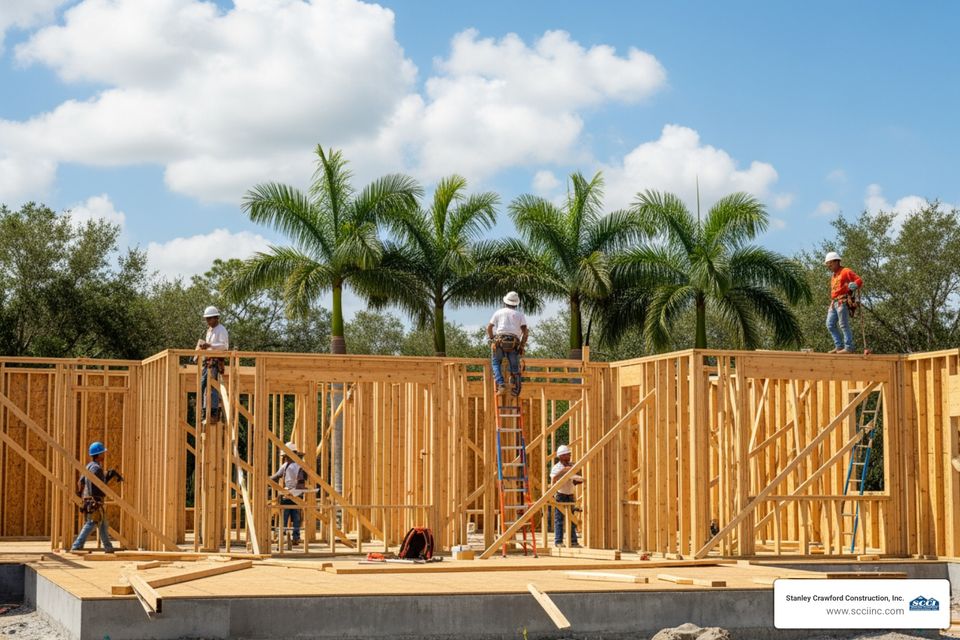
Framing and structural work (2-3 months) — walls, roof, windows, and doors
Rough-ins (1-2 months) — plumbing, electrical, and HVAC installation
Insulation and drywall (1-2 months) — sealing and finishing interior walls
Interior and exterior finishes (2-4 months) — flooring, cabinetry, paint, and fixtures
Final inspections and walkthrough (1-2 months) — punch list, certificate of occupancy, and closing
If you've ever tried to research building a custom home, you know how quickly things get overwhelming. There are architects, builders, permits, budgets, subcontractors, material selections, and timelines — all moving at once. One wrong step and you're looking at delays, cost overruns, or worse.
And that's before you've even broken ground.
As a custom home builder in High Springs, Alachua, Gainesville, Newberry, and the Town of Tioga, we know that building in North Central Florida comes with its own unique set of considerations. Local soil conditions, Florida's unpredictable weather, and regional permitting requirements all play a real role in how your project unfolds.
This guide walks you through every phase of the process clearly and honestly, so you can move forward with confidence — not confusion.
Understanding the Custom Home Building Process vs. Production Homes
When most people think of a "new home," they picture a production or "spec" home. You drive through a neighborhood, pick one of three floor plans, and maybe choose between two shades of beige carpet. The custom home building process is a completely different animal.In a custom build, you aren't just buying a house; you're creating a one-of-a-kind living space. There is no pre-set blueprint unless you bring one. You have total design flexibility, allowing you to tailor every square inch to your family’s lifestyle. If you want a mudroom specifically designed for your kids' muddy soccer cleats or a kitchen island large enough to host a Thanksgiving feast for twenty, you can have it.
This level of personalization is why custom homes often take longer. While a production home might be finished in 7 to 9 months, a custom home generally requires 10 to 16 months or more, depending on the complexity. However, the result is a home that reflects your identity rather than a developer's bottom line. For more on the creative side of this, check out Beyond the Blueprint: Crafting Unique Modern Home Designs.
Why the Custom Home Building Process Offers Better Value
It’s a common misconception that custom homes are always more expensive. While the sticker price might be higher, the value is often superior. In a production build, you often pay a premium for every "upgrade." In the custom world, we work with transparent pricing structures where you see exactly where your money goes.You have total material control. You can choose to invest in high-efficiency spray foam insulation and impact-resistant windows to lower your North Central Florida utility bills, while perhaps saving money on guest room flooring. This control leads to long-term durability and energy efficiency that production homes often lack.
According to the U.S. Census Bureau Construction Data, owner-built or contractor-built homes often involve higher quality standards because the homeowner is involved in every inspection and material choice.
Local Expertise in High Springs and Alachua
Geography matters. Building in Alachua or High Springs isn't the same as building in South Florida or the Midwest. We deal with specific regional aesthetics — think modern farmhouse or classic Southern coastal — and very specific soil conditions.North Central Florida features a mix of sandy soil and clay, which dictates how we pour foundations. Understanding the local climate is also crucial; we use climate-specific materials that can handle the humidity and the occasional hurricane-force winds. Working with a Custom Home Builder Alachua Florida ensures that your home is structurally sound for our specific environment.
The Pre-Construction Phase: Planning, Design, and Permits
Before a single shovel hits the dirt, we spend months in the pre-construction phase. This is often the most time-consuming part of the custom home building process, taking anywhere from 3 to 12 months.It starts with lot selection. Not all land is created equal. You need to consider zoning laws, setbacks, and easements. We perform a site analysis to see if the land is buildable or if it requires significant clearing and grading. Environmental regulations in Florida are strict, especially regarding wetlands and protected species.
According to NAHB Lot Values, the average lot price hit record highs recently, making it even more important to ensure your land can support your vision. Once the land is secured, we move into architectural drawings. This is where your "needs, wants, and wishes" list becomes a reality. For a deep dive into this, see our Step-by-Step Guide to Home Design Consultation.
Navigating the Custom Home Building Process Permits in Gainesville and Newberry
Permitting can be a headache, but it’s a necessary one. In Gainesville and Newberry, municipal codes are specific. You’ll need to account for impact fees — these are one-time payments made to the local government to help fund public infrastructure like roads and parks.We also have to coordinate utility hookups. Is your lot on city water and sewer, or do we need to permit a well and septic system? In areas like High Springs, septic permits require soil "perc" tests to ensure the ground can handle the system. As your Custom Home Builder High Springs Florida, we handle these technical hurdles so you don't have to navigate city hall alone.
Securing Financing and Construction Loans
Financing a custom home is different from a traditional mortgage. Most homeowners use a construction loan, which is a short-term loan that pays for the build in stages, known as "draws."Typically, you’ll need a 20% down payment. During the build, you usually make interest-only payments on the amount that has been drawn. Once the home is finished and receives a Certificate of Occupancy, the construction loan "converts" into a permanent 15- or 30-year mortgage.
It’s vital to speak with a lender who understands the custom home building process to ensure a smooth transition from the construction phase to long-term financing.
Breaking Down the Main Stages of Construction
Once the permits are in hand and the loan is closed, the real fun begins. We break ground!The first step is site preparation. We clear the trees (saving the ones you love), grade the land for proper drainage, and dig the footings. Then comes the foundation. In Florida, this is typically a reinforced concrete slab, though some custom designs may call for a crawl space or stem wall.
Next is the framing stage. This is when your house actually starts to look like a house. The "skeleton" of the home is built, including the interior walls and the roof system. If you want to understand how we integrate design and construction during this phase, take a look at our Beginner's Guide to Design-Build Services.
After framing, we move into the "rough-ins":
- HVAC Installation: Ductwork is run throughout the house.
- Plumbing Rough-ins: Water lines and drain pipes are positioned.
- Electrical Wiring: Outlets, switches, and lighting boxes are installed.
Once the rough-ins pass inspection, we install insulation and drywall. This is a milestone moment for homeowners because the "rooms" finally feel real.
Exterior and Interior Finishes in the Town of Tioga
In luxury markets like the Town of Tioga, the finishes are what truly set a custom home apart. This stage includes everything that you see and touch.On the exterior, we install roofing (shingles, metal, or tile) and siding (stucco, Hardie board, or brick). Inside, we bring in the cabinetry, flooring, and trim. This is where your personal style shines. Whether you’ve chosen quartz countertops or hand-scraped hardwood floors, our team provides selection guidance to ensure your choices are both beautiful and durable.
Lighting fixtures and final paint colors are the "jewelry" of the home, added toward the end of this 2-to-4-month finishing phase.
The Role of Inspections in the Custom Home Building Process
Inspections aren't just a bureaucratic hurdle; they are your best friend. They ensure code compliance, structural integrity, and safety.Throughout the custom home building process, there are several key inspections:
Foundation Inspection: Before concrete is poured.
Framing/Rough-in Inspection: After the skeleton and utilities are in but before the walls are closed.
Insulation Inspection: To ensure energy efficiency standards are met.
Final Inspection: To ensure the home is safe for habitation.
The goal is to receive the Certificate of Occupancy (CO), which officially allows you to move in. We encourage our clients to attend these inspections to learn more about the inner workings of their new home.
Managing Your Budget and Avoiding Common Pitfalls
Building a home is a massive investment, and "scope creep" is the enemy of every budget. Scope creep happens when small changes — like adding an extra window or upgrading to a more expensive tile — slowly inflate the total cost.To manage this, we recommend a contingency fund of 10% to 15% of the total construction cost. This isn't for "extra" stuff; it's for the unexpected, like hitting a limestone shelf during excavation. As the SCCI Stanley Crawford Lake City FL: Top Choice for Custom Home Building, we prioritize transparent communication to help you avoid decision fatigue and keep change orders to a minimum.
Tips for Staying on Schedule in North Central Florida
Time is money, and in Florida, the weather is the biggest variable. Hurricane season (June through November) can bring heavy rains that stall site work.To stay on schedule:
- Plan for Rain: We build buffers into our timelines for summer afternoon thunderstorms.
- Proactive Communication: We keep you updated on lead times for materials like windows or custom cabinetry, which can sometimes take months to arrive.
- Selection Deadlines: Making your finish selections early prevents delays when the subcontractors are ready to install them.
Choosing the Right Building Team
Your builder is your partner for at least a year. You need someone with a solid local reputation and strong subcontractor relationships. When reviewing portfolios, don't just look at the pretty pictures; ask for client testimonials. A builder who has been in the Gainesville and Lake City area for 40 years, like we have, has the deep-rooted connections needed to get the best crews on your job site.Final Walkthrough, Closing, and Moving In
The finish line is in sight! Before you move your furniture in, we conduct a "blue tape" walkthrough. We walk through every room with you, looking for any minor imperfections — a paint scuff, a loose cabinet handle, or a scratch on a floorboard. These items go on a "punch list" to be fixed before closing.During this time, we also do a mechanical orientation. We’ll show you how to operate your HVAC system, where your water shut-off valve is, and how to program your smart home features.
Finally, we head to closing. You’ll sign the final documents, the construction loan converts to your mortgage, and we hand you the keys. You’ll also receive a packet containing all manufacturer warranties for your appliances and our builder home warranty, which provides peace of mind for the years to come.